Out of the Blue
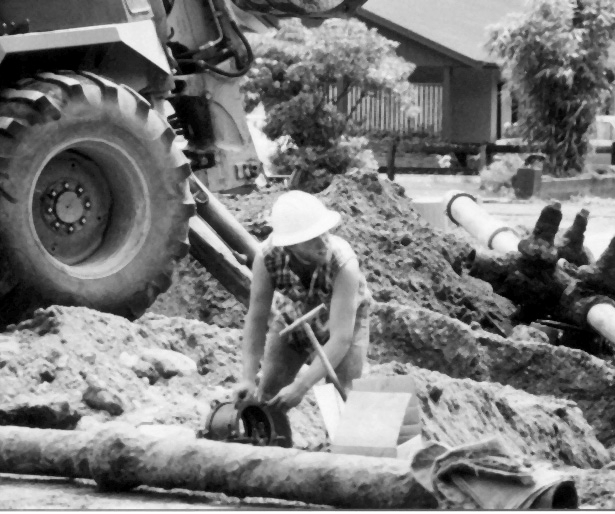
Michael Ippen working as a Ditchpig.
by Michael Ippen
Fucking George didn’t know what to do with John the Elder on his first day back after his daughter died. She fell off a barn roof on a farm in southern Ontario, where his Ex and her third husband lived. Didn’t stand a chance, poor kid, and only thirteen to boot. John took off the day he heard, and we never knew when — or if — he was coming back. So, Fucking George put him with me. On Construction. I didn’t ask why, but Hollywood said it was because I’d been John’s first supervisor when he’d started his Ditchpig career, back in ‘eighty-one.
It was slow season, being January, but the weather was fine even if it was as cold as a parole officer’s heart most mornings. We’d been doing small jobs, like installing water services and fire hydrants, which the smaller crews could have done but always found an excuse not to. Fine with Johnny Too Tall, Waldo, Hollywood, and me. We liked being busy, in one place, instead of driving around like Company Man checking complaints and looking for leaks. Looking at girls and avoiding work, it seemed to us. But to each his own.
John The Elder came back on a Tuesday. The day was cold and clear, frost on the roof and a scrim of ice on the puddles. The sky so blue and endless it hurt your eyes if you stared into it too long. John arrived in the barn just as we were loading our truck with the fittings we needed for the day. Everybody stopped in their tracks and tried not to stare, but it was hard. When he’d left for Ontario, his hair had been black, as dark as Freddie and Frank’s. Now a thick slash of white bisected his scalp, from crown to widow’s peak. It matched the silvery stubble on his unshaven chin. We tried to make like we were cool as we shook John’s hand, but one look in his eyes and we lost our courage, along with our voices. Except for Waldo, who screeched out Welcome Back Johnny! in a voice two octaves too high as he ran one hand through John The Elder’s hair. John winced, as if in pain, but he didn’t clock Waldo or anything like that. He grunted a weak ‘how’s it going’ and brushed past us into Fucking George’s office. He reappeared after five minutes with his rain gear and hard hat and vest and flung himself into the back seat of our pickup. He stared straight ahead as we loaded the fittings we needed. We were heading to Marine Drive, or just south of it, to cut in a fire line for the new ICBC claim centre that was still under construction.
It was a quiet ride to the site. Johnny Too Tall sat in front with me; John The Elder had the backseat to himself. Waldo, feeling awkward, rode with Hollywood. John did not move. It seemed to me, as I glanced at him in the rear-view mirror, that he didn’t even breathe. Just frozen, staring out the window as we drove west along Marine Drive. I tried to see what was going on beneath his exhausted features, but it pained me to look at him for very long. Like his very presence was a reminder of stuff we just didn’t think about; certainly not on a glorious, icy January morning as we headed to work.
His skin was pale. His crow’s feet had been chiselled by grief into deep crevices. His shoulders slumped like wet cement. We knew for sure he was different because he didn’t insist on stopping for a coffee and donut. And no newspaper to read — or pretend to read — while the rest of us worked. When we arrived on site Hollywood and Waldo had already set up signs, a rare thing. Must have been the excitement of John The Elder’s return. Hollywood and John played on the same ball team for the past few summers, but Kenny said that John never called since he’d headed east. He wasn’t even sure he’d come back from Ontario.
The pavement had been saw cut the day before, so it didn’t take long for Waldo to rip out the asphalt and load it onto Hollywood’s truck. Kenny took it to the dump, then returned with a load of clean gravel for backfill. Johnny Too Tall and I were in the ditch, prepping to tap the water main. John the Elder remained in the backseat, staring out the window or, occasionally, staring at his hands. Nobody had the heart to tell him that there was a job to be done.
I was tightening up the tapping saddle to make the new connection when Hollywood hit the truck horn a half-dozen times, splitting the quiet. We jumped out of our skins, as we’d closed the street and our equipment was shut down. He wheeled down the window and gestured madly at us to get out of the ditch. I thought there’d been an accident but everything around me was the same: a stunning January morning.
“You guys!” Hollywood shouted, pointing at his truck radio. “The space shuttle blew up!”
We hopped out of the trench. Everyone had been talking about the launch, what with it carrying the first teacher into space. The guys gave me the gears, saying I should have applied for the space program. Waldo clambered out of his backhoe. We hung like groupies beneath Kenny’s door, listening to the news. As the broadcast described the final moments of the Challenger, we scanned the sky, as if evidence of the disaster would be visible thousands of miles away. The cloudless sky mocked us with its sapphire emptiness.
John the Elder opened his door and walked over to Kenny’s truck, one hand behind his left ear, to hear better. We shared a look, Johnny Too Tall, Hollywood, and I, but said nothing. John the Elder listened to the news through the next commercial break, wiped his eyes, and picked up the torque wrench I’d dropped. He jumped into the trench to finish tightening the tapping saddle. He began to whistle, never once looking up; never once pausing to search that perfect, blue sky like the rest of us.
Michael was born in Vancouver, British Columbia. His first novel, The Raven Effect, was self-published in 2011. His novel of the Armenian Genocide, Saint Illuminator’s Daughter, was self-published in 2019. His short fiction has appeared in Island Writer, Halfway Down the Stairs, and Commuter Lit.
“Out of the Blue” is his first appearance in The Itch.
